
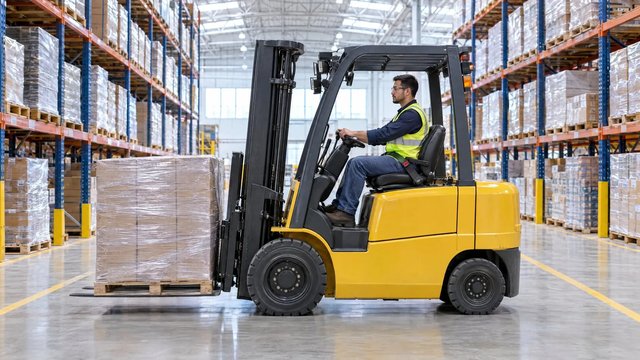
Oregon runs its own workplace safety agency, Oregon OSHA, and its powered industrial truck rules sit in Division 2, Subdivision N, alongside federal 29 CFR 1910.178 and OAR 437-002-0227. Oregon OSHA says operators need classroom instruction, hands-on training and an evaluation of their competency in the workplace, and the employer must certify each operator. The classroom portion can be taken online. Gama Safety’s course is US$59 and is aligned with 29 CFR 1910.178. OSHA does not approve online training providers, and Oregon has no forklift license.
Quick facts: forklift certification in Oregon
| Regulator | Oregon OSHA (Oregon Occupational Safety and Health Division, within the Department of Consumer and Business Services) |
|---|---|
| Governing rule | Oregon Division 2, Subdivision N (material handling and storage), 29 CFR 1910.178 and OAR 437-002-0227, as listed by Oregon OSHA |
| State Plan or federal OSHA | OSHA-approved State Plan covering private and public employers |
| Online allowed? | Yes, for the formal instruction (classroom) part only |
| Hands-on required? | Yes: practical training and a workplace evaluation by the employer |
| Evaluation renewal | At least once every 3 years, and sooner after an accident, near-miss or unsafe operation |
| Minimum age | 18 for non-farm work under the federal Fair Labor Standards Act (Hazardous Occupations Order 7) |
| Typical cost | Online courses commonly $40 to $80; employer training is often paid by the employer |
| Gama online course | US$59 with certificate, wallet card and unlimited exam retakes |
The short answer
Oregon is a State Plan state, so Oregon OSHA, not federal OSHA, sets and enforces workplace rules for most Oregon employers. On its powered industrial trucks topic page, Oregon OSHA says forklift operators must have classroom instruction, hands-on training, and an evaluation to determine their competency. The rules it points employers to include Division 2, Subdivision N, the federal text of 29 CFR 1910.178, and Oregon’s own additions in OAR 437-002-0227.
Because the structure is the same as the federal rule, a person who has finished an online forklift course has done the first of the three parts. The other two, hands-on training and a workplace evaluation, are still the employer’s job. There is no Oregon forklift card issued by the state.
Step by step: forklift certification in Oregon
- Complete the online instruction. Choose a course that covers the 1910.178(l)(3) topics: truck controls, steering, visibility, capacity and stability, inspection and maintenance, refueling or battery charging, surface conditions, load handling, pedestrians, narrow aisles, ramps and ventilation.
- Pass the exam. Gama Safety’s pass mark is 80%, and retakes are unlimited and free.
- Save your certificate and wallet card. Both are available as soon as you pass, so you can send them with job applications.
- Get practical training on the actual truck. A qualified trainer demonstrates the truck and then supervises you while you practice. Training given off site has to be supplemented with on-site training on your employer’s specific hazards and tasks.
- Be evaluated at work. The evaluator watches your pre-shift inspection, travel, stacking and load handling in the real work area.
- Receive your employer’s certification. Oregon OSHA says the certification must include your name, the trainer’s name and the dates of training and evaluation.
Get your Forklift certificate today
Theory 100% online · unlimited free retakes · instant certificate + printable wallet card · employer practical evaluation required
What an online course can and cannot do
Oregon OSHA’s guidance treats classroom instruction as a distinct element, and OSHA’s rule allows interactive computer learning to deliver it. Online learning can therefore satisfy that element. It cannot replace the other two.
The workplace evaluation must be done in your actual work setting so the evaluator can observe typical tasks. A generic online certificate, or a hands-on session somewhere else, does not by itself let your employer skip the on-site portion. That is the main reason to treat any “instant Oregon certification” claim with suspicion.
What is specific to Oregon
Several details from Oregon OSHA’s guidance are worth knowing before you start a job:
- Evaluation happens in the workplace. The trainer needs to watch you perform your typical tasks in the setting where you will actually work.
- Third-party training is allowed, with a catch. An outside provider can deliver training and evaluation, but off-site training has to be supplemented with on-site training that covers the specific hazards and tasks at your employer’s site.
- The employer certifies. The certification must include the operator’s name, the trainer’s name and the dates of the training and the evaluation.
- Oregon-specific additions. OAR 437-002-0227 adds Oregon requirements on top of the federal text, covering matters such as overhead guard specifications and lifting people on a work platform. If your job involves either, ask your employer how they meet the Oregon rule.
- Different subdivisions for different industries. Oregon OSHA also lists powered industrial truck provisions in Division 3 (construction) and Division 4 (agriculture) subdivisions. Check which division applies to your work.
Where forklift operators work in Oregon
Oregon’s forklift jobs cluster along the I-5 corridor and around its industries:
- Portland metro: the Port of Portland, Rivergate and Swan Island freight areas, plus warehouses in Gresham, Troutdale and Wilsonville.
- Tech and manufacturing: Hillsboro and Beaverton suppliers and fabrication plants.
- Wood products and building supply: mills and lumber yards in the Willamette Valley, southern Oregon and eastern Oregon.
- Food and agriculture: nurseries, produce packers, breweries and beverage distributors from Salem and Eugene to the Columbia Gorge.
Outdoor lumber yards and rainy-season loading docks mean traction, visibility and load stability come up often in site-specific training.
How long it takes and what it costs
- Online instruction: about 1.5 to 2 hours, self-paced.
- Hands-on training and evaluation: normally arranged by your employer and often completed in a few hours.
- Online course price: Gama Safety’s forklift course is US$59 with a certificate, printable wallet card and unlimited retakes. Others commonly cost $40 to $80.
- Classroom-plus-truck programs usually cost several hundred dollars.
Renewal and refresher training
Oregon’s powered industrial truck rules build on 29 CFR 1910.178, which requires an evaluation of each operator at least once every three years. Refresher training is also required after unsafe operation, an accident or near-miss, a poor evaluation, assignment to a different type of truck or a change in workplace conditions. Because the evaluation is tied to your workplace, moving to a new Oregon employer means the new employer has to confirm your competence on its own trucks.
Hands-on training options
Gama Safety runs in-person forklift classes only in Fresno, California (forklift certification in Fresno, CA). We do not run a class in Oregon. If a Oregon employer wants hands-on training for a crew, ask about it through our in-person training page. Many Oregon workers receive the practical training and evaluation at the worksite on the exact truck type they will drive.
For employers and safety managers
Oregon employers should keep the certification record Oregon OSHA describes: operator name, trainer name, and the training and evaluation dates. 29 CFR 1910.178(l)(6) lists the same items. If you use an outside trainer, add on-site training for site-specific hazards before the evaluation.
Gama Safety’s online course covers the classroom element, issues a certificate for each trainee and offers team seat pricing on the course page. Your own evaluator then completes the hands-on training and evaluation.
Sources
- OSHA, 29 CFR 1910.178, Powered industrial trucks, paragraph (l) Operator training.
- Oregon OSHA, Powered industrial trucks topic page.
- Oregon OSHA, Operating powered industrial trucks (fact sheet).
- OSHA, State Plans, which lists states that run their own programs.
Frequently asked questions
Do I need a forklift license in Oregon?
No. Oregon does not issue a forklift license. Oregon OSHA expects classroom instruction, hands-on training and a workplace evaluation, and your employer certifies that each operator completed them. Ask your employer for a copy of your training record, because that is the document an inspector or a new employer will ask to see.
Can I get forklift certified online in Oregon?
The classroom instruction can be done online. Oregon OSHA also requires hands-on training and an evaluation in the workplace, so you will still need your employer to complete those parts before you operate independently. Gama Safety’s course covers the classroom portion and gives you a certificate to show employers at hiring, while your employer completes the rest.
How much does forklift certification cost in Oregon?
Online courses commonly cost $40 to $80, and Gama Safety’s is US$59. Hands-on training is usually arranged and paid for by the employer, and classes with truck time cost more. Prices vary by provider, so check what is included before you buy, such as the certificate, wallet card and free exam retakes.
How long is a forklift certification valid in Oregon?
Oregon follows the federal baseline of an operator evaluation at least every three years, with refresher training sooner after unsafe operation, an accident, a near-miss or a change to a different truck type. Keep a note of your last evaluation date so you know when the next one is due, even if you change jobs.
Can an outside company train my forklift operators in Oregon?
Yes. Oregon OSHA says a third party can conduct training and evaluation, but off-site training must be supplemented with on-site training that covers the hazards and tasks at your specific workplace. If you are unsure which rules cover your workplace, ask your employer’s safety contact or the regulator directly.
What must an Oregon forklift certification record include?
Oregon OSHA says the certification must include the operator’s name, the trainer’s name, and the dates of the training and evaluation. Federal rule 1910.178(l)(6) lists the same items. If you are unsure which rules cover your workplace, ask your employer’s safety contact or the regulator directly.
Is forklift training different in Portland or Eugene?
No. Oregon OSHA rules apply statewide. The training you need depends on your employer’s truck types, such as warehouse reach trucks or rough-terrain lumber yard forklifts. If you are unsure which rules cover your workplace, ask your employer’s safety contact or the regulator directly.
How old do you have to be to drive a forklift in Oregon?
Federal Hazardous Occupations Order 7 sets 18 as the minimum age for operating forklifts in non-farm work. Employers can require more, and agricultural work follows separate rules. Check your employer’s own policy as well, since many companies and insurers set a higher minimum age for lift truck drivers.
Other states
Related