
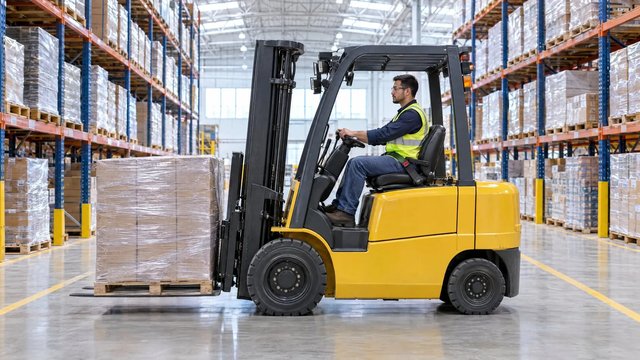
Forklift training rules come from federal OSHA, 29 CFR 1910.178(l), in most states, and from an OSHA-approved State Plan in about two dozen others. No state issues a forklift “license” to general operators. In every state the pattern is the same: formal instruction (which can be done online), practical training on the truck, and an evaluation of the operator in the workplace, with the employer certifying that all three were done. Evaluations are repeated at least every 3 years. Use this guide to find your state’s regulator, then start the online instruction for US$59.
The short answer
The question “what are the forklift certification rules in my state?” has a simple answer in most places and a slightly more detailed one in a few. The federal standard, 29 CFR 1910.178(l), requires employers to ensure that each powered industrial truck operator is competent, shown by completing a training program with formal instruction, practical training and an evaluation of performance in the workplace. The employer must certify the training and evaluation and keep a record with the operator’s name, the training date, the evaluation date and the name of the person who trained or evaluated.
That rule applies directly in states where federal OSHA is the regulator, and it is mirrored (or in a few states, rewritten) by the state agency in State Plan states. Either way, OSHA does not approve, certify or accredit online training providers, and a web course alone cannot complete the practical training and evaluation.
Federal OSHA versus State Plan states
Under the Occupational Safety and Health Act, a state may run its own workplace safety program if OSHA approves it, as long as the program is at least as effective as the federal one. These are called State Plans. According to OSHA’s State Plans page, there are currently two kinds:
- 22 State Plans covering both private-sector and state and local government workers. These are Alaska, Arizona, California, Hawaii, Indiana, Iowa, Kentucky, Maryland, Michigan, Minnesota, Nevada, New Mexico, North Carolina, Oregon, Puerto Rico, South Carolina, Tennessee, Utah, Vermont, Virginia, Washington and Wyoming.
- Seven State Plans covering only state and local government workers: Connecticut, Illinois, Maine, Massachusetts, New Jersey, New York and the U.S. Virgin Islands. Private employers in these states are covered by federal OSHA.
In every other state, federal OSHA is the regulator for private employers. In states without a State Plan that covers them, state and local government employees are generally not covered by OSHA at all, so public employers follow their own written policies. The list changes occasionally, so check osha.gov/stateplans for the current status.
Why no state issues a forklift license
Many websites advertise a state “forklift license”. In reality the training duty falls on the employer. The employer trains, evaluates and certifies, and what you carry is the employer’s certification plus any course certificate that shows you completed the classroom portion. A card from an online course is proof of instruction, not a government permit.
One state deserves a note. Michigan’s MIOSHA rules (Part 21) provide for an employer-issued operator permit that is valid for up to three years and only with the employer that issued it. It is still an employer document, not a state license, and the details are in our Michigan guide.
Get your Forklift certificate today
Theory 100% online · unlimited free retakes · instant certificate + printable wallet card · employer practical evaluation required
What is the same in every state
- Three parts. Formal instruction, practical training and a workplace evaluation. Interactive computer learning counts as formal instruction.
- Employer certification. The employer certifies that each operator was trained and evaluated.
- Truck and site specific. Training must fit the type of truck and the workplace. A new truck type means more training.
- Evaluation at least every three years, with refresher training after unsafe operation, an accident or near-miss, a poor evaluation, a new truck type or a change in workplace conditions.
- Minimum age of 18 for non-farm work under federal child labor rules (Hazardous Occupations Order 7).
States with a dedicated guide
Each of these states has its own page with the regulator, the rule, local industries and frequently asked questions.
| State | Who regulates | Rule |
|---|---|---|
| Arizona | ADOSH (State Plan) | State Plan; see guide for the rule |
| California | Cal/OSHA (State Plan) | Title 8 CCR section 3668 |
| Colorado | Federal OSHA | 29 CFR 1910.178(l) |
| Florida | Federal OSHA | 29 CFR 1910.178(l) |
| Georgia | Federal OSHA | 29 CFR 1910.178(l) |
| Illinois | Federal OSHA for private employers; state plan covers public employees only | 29 CFR 1910.178(l) |
| Indiana | IOSHA (State Plan) | State Plan; see guide for the rule |
| Michigan | MIOSHA (State Plan) | General Industry Part 21, R 408.12151 to R 408.12154 |
| Nevada | Nevada OSHA (State Plan) | State Plan; 1910.178(l) as the benchmark |
| New Jersey | Federal OSHA for private employers; PEOSH for public employees | 29 CFR 1910.178(l) |
| New York | Federal OSHA for private employers; PESH for public employees | 29 CFR 1910.178(l) |
| North Carolina | NCDOL OSH Division (State Plan) | 13 NCAC 07F, adopting the federal standard |
| Ohio | Federal OSHA | 29 CFR 1910.178(l) |
| Oregon | Oregon OSHA (State Plan) | State Plan; see guide for the rule |
| Pennsylvania | Federal OSHA | 29 CFR 1910.178(l) |
| Texas | Federal OSHA | 29 CFR 1910.178(l) |
| Utah | Utah OSHA (State Plan) | State Plan; see guide for the rule |
| Washington | Washington L&I, DOSH (State Plan) | State Plan; see guide for the rule |
Every other state
These states do not yet have a dedicated guide. Use the note to find the regulator, and follow the same three-part process: online instruction, practical training, workplace evaluation. State Plan details are as listed by OSHA; for the exact state rule text, contact the state agency.
Alabama: federal OSHA, 29 CFR 1910.178(l). Alaska: Alaska Occupational Safety and Health (AKOSH), a State Plan covering private and public employers. Arkansas: federal OSHA. Connecticut: federal OSHA for private employers; the state plan covers public employees only. Delaware: federal OSHA. Hawaii: Hawaii OSHA (HIOSH), a State Plan covering private and public employers. Idaho: federal OSHA. Iowa: Iowa OSHA, a State Plan covering private and public employers. Kansas: federal OSHA. Kentucky: Kentucky OSH, a State Plan covering private and public employers. Louisiana: federal OSHA. Maine: federal OSHA for private employers; the state plan covers public employees only. Maryland: Maryland Occupational Safety and Health (MOSH), a State Plan covering private and public employers. Massachusetts: federal OSHA for private employers; per OSHA’s current listing the state plan covers public employees only.
Minnesota: MNOSHA, a State Plan covering private and public employers. Mississippi: federal OSHA. Missouri: federal OSHA. Montana: federal OSHA. Nebraska: federal OSHA. New Hampshire: federal OSHA. New Mexico: New Mexico OSHA Bureau, a State Plan covering private and public employers. North Dakota: federal OSHA. Oklahoma: federal OSHA. Rhode Island: federal OSHA. South Carolina: South Carolina OSHA, a State Plan covering private and public employers. South Dakota: federal OSHA. Tennessee: TOSHA, a State Plan covering private and public employers. Vermont: Vermont OSHA (VOSHA), a State Plan covering private and public employers. Virginia: Virginia Occupational Safety and Health (VOSH), a State Plan covering private and public employers. West Virginia: federal OSHA. Wisconsin: federal OSHA. Wyoming: Wyoming OSHA, a State Plan covering private and public employers.
Federal territories and the District of Columbia are outside this guide, apart from Puerto Rico, which has a State Plan, and the U.S. Virgin Islands, whose plan covers public employees only.
What an online course can do in any state
Interactive computer learning is recognised as a valid way to deliver formal instruction, so you can complete the classroom portion of forklift training online from a phone, tablet or computer in any state. The practical training and the workplace evaluation cannot be done online, because they require a real truck and a qualified evaluator in your workplace. Treat claims of “instant 100% online forklift certification” with caution. For more, read is online forklift certification OSHA approved?
The same five steps in every state
- Take an online forklift course that covers the 1910.178(l)(3) topics.
- Pass the exam. Gama Safety’s pass mark is 80%, retakes are unlimited and free, and the certificate and wallet card are available immediately.
- Complete practical training from your employer on the type of truck you will drive.
- Be evaluated in the workplace by someone with the knowledge and experience to judge competence.
- Get your employer’s certification and renew with a new evaluation within three years.
Cost and time
The online instruction takes about two hours. Gama Safety’s forklift course is US$59 and includes the certificate, a printable wallet card and unlimited exam retakes. Practical training and evaluation usually take a few hours and are provided by the employer. In-person classes with truck time cost more.
Hands-on options
Gama Safety’s in-person classes are currently offered only in Fresno, California: forklift certification in Fresno, CA. Everywhere else, the practical training and evaluation come from your employer. Businesses that want crew training in another state can send a request through our in-person page.
For employers and training managers
Team pricing is on the forklift course page. Under 1910.178(l)(6), keep a certification record for each operator that shows the operator’s name, the training date, the evaluation date and the name of the person who trained or evaluated. If you operate in several states, build one program around the federal standard and check each State Plan state for differences. Michigan and California, for example, have their own written rules.
Sources
- OSHA, State Plans, current list of State Plans.
- OSHA, 29 CFR 1910.178, Powered industrial trucks.
- eCFR, 29 CFR 1910.178.
- U.S. Department of Labor, Child labor rules for non-agricultural occupations.
Frequently asked questions
Is there a national forklift license?
No. There is no national or state forklift license for general operators. The federal OSHA rule makes the employer responsible for training, evaluating and certifying each operator.
Which states have their own OSHA program?
OSHA lists 22 State Plans covering private and public workers, including California, Michigan, Washington, Oregon, Arizona and North Carolina, plus seven plans covering only public employees, such as New York and New Jersey.
Is forklift certification the same in every state?
The core requirements are the same: formal instruction, practical training, a workplace evaluation and employer certification. A few State Plan states, like California and Michigan, have their own written rules.
Can I use a forklift certificate from another state?
A course certificate shows you completed formal instruction. A new employer must still train and evaluate you on its own trucks and certify you, regardless of where you trained.
Can I get forklift certified online in any state?
You can complete the formal instruction online in any state. The practical training and the workplace evaluation must be done in person by your employer or a qualified evaluator.
How long does forklift certification last?
Operators must be evaluated at least once every three years under the federal rule, with refresher training sooner after unsafe operation, an accident or near-miss, or a change of truck or workplace.
Do public employees need forklift training too?
In states without a covering State Plan, federal OSHA does not cover state and local government workers, so public employers set their own written programs. Many follow the OSHA standard.
How much does online forklift training cost?
Gama Safety’s online forklift course is US$59 and includes the certificate, a wallet card and unlimited retakes. In-person classes with truck time cost more.
Related