
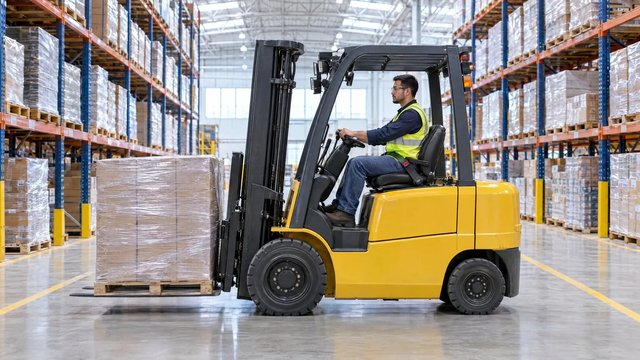
This free forklift practice test has 20 original sample questions with the correct answer and an explanation for each one. The questions are based on OSHA’s powered industrial truck standard, 29 CFR 1910.178, and cover inspection, stability, load handling, traveling, loading docks, fueling and charging, and operator training rules. This is a study aid, not the exam for any course, and it does not replace the hands-on training and evaluation your employer must provide.
How to use this practice test
Cover the answers, pick your choice for each question, then check the explanation. If you miss a question, read the matching rule in 1910.178 or take the full course for a structured review. Score yourself at the end: 16 or more correct (80%) is a good sign you are ready for a course exam. Gama Safety’s course exam has an 80% pass mark and unlimited free retakes.
These questions test knowledge of the rules. They do not test how well you drive, and no practice test can. Your employer must still train you on your truck and evaluate your performance in the workplace before you operate independently.
Part 1: Inspection, capacity and stability (questions 1 to 5)
1. How often must a powered industrial truck be examined for defects before it is used?
A. Once a month
B. Before being placed in service, and at least daily (after each shift if used around the clock)
C. Only after an accident
D. Once a year
Answer: B. 1910.178(q)(7) requires examination before the truck is placed in service and at least daily, and after each shift when trucks are used around the clock. Defects must be reported and corrected right away.
2. You find a hydraulic leak during your pre-shift check. What should you do?
A. Operate the truck carefully and report the leak at the end of the shift
B. Top up the fluid and keep going
C. Do not use the truck, report the defect and tag it out of service
D. Use it only for light loads
Answer: C. A truck that is unsafe or in need of repair must be removed from service until it is restored to a safe condition (1910.178(p)(1) and (q)(1)).
3. Where do you find the truck’s rated capacity?
A. In the warehouse safety policy
B. On the data plate or nameplate on the truck
C. On the load itself
D. In the dock schedule
Answer: B. The truck’s nameplates and markings must stay in place and legible (1910.178(a)(6)), and the plate shows the capacity. Handle only loads within the truck’s rated capacity (1910.178(o)(2)).
4. A company adds a non-factory attachment to a truck. What must be true?
A. Nothing, attachments are always allowed
B. The truck must be marked to identify the attachment and show the approximate weight of the truck and attachment, and changes that affect capacity need the manufacturer’s prior written approval
C. Only the operator must be told
D. The attachment must be painted yellow
Answer: B. 1910.178(a)(4) says modifications or additions that affect capacity or safe operation need the manufacturer’s prior written approval, with the plates updated to match. Under (a)(5), a truck with a non-factory attachment must be marked to identify it and show the approximate weight of the truck and attachment.
5. Which part of the truck protects you from falling small objects such as packages?
A. The load backrest extension
B. The tilt cylinder
C. The overhead guard
D. The forks
Answer: C. 1910.178(m)(9) calls for an overhead guard to protect against falling objects. It is intended to protect against small packages, not the impact of a falling load at full capacity. A load backrest extension, covered in (m)(10), keeps the load from falling backward toward the operator.
Part 2: Handling loads (questions 6 to 10)
6. How should you place the forks under a load?
A. Only the tips under the load
B. As far under the load as possible, then tilt the mast back carefully to stabilize it
C. Halfway under the load with the mast tilted forward
D. Wherever is fastest
Answer: B. 1910.178(o)(5) says to place the forks as far under the load as possible, then carefully tilt the mast backward to stabilize the load.
7. When may you tilt the mast forward with the forks elevated?
A. Any time you want to speed up unloading
B. Only to pick up a load, or when the load is over a rack or stack and ready to be placed
C. While traveling
D. Only on ramps
Answer: B. 1910.178(o)(6) says not to tilt forward with forks elevated except to pick up a load, and to tilt an elevated load forward only when it is over a rack or stack.
8. A load is unstable and could fall. What is the correct action?
A. Drive slowly so it stays on
B. Handle only loads that are stable or safely arranged, and re-stack or secure the load first
C. Have a coworker hold it
D. Raise it quickly to get it over with
Answer: B. 1910.178(o)(1) requires handling only stable or safely arranged loads, with caution for off-center loads that cannot be centered.
9. Can you let a coworker stand under the raised forks if the forks are empty?
A. Yes, if empty
B. Yes, if they are quick
C. No, nobody may stand or pass under the elevated portion of any truck, loaded or empty
D. Yes, if the engine is off
Answer: C. 1910.178(m)(2) prohibits anyone from standing or passing under the elevated portion of any truck, whether it is loaded or empty.
10. Can a passenger ride on the forks or the truck if they ask nicely?
A. Yes, for short distances
B. Yes, standing on the forks if the mast is low
C. No, unauthorized personnel may not ride on powered industrial trucks
D. Yes, on pallets
Answer: C. 1910.178(m)(3) says unauthorized personnel must not be allowed to ride on powered industrial trucks, and that where riding is authorized, a safe place to ride must be provided.
Get your Forklift certificate today
Theory 100% online · unlimited free retakes · instant certificate + printable wallet card · employer practical evaluation required
Part 3: Traveling and ramps (questions 11 to 15)
11. What following distance should you keep behind another truck?
A. Bumper to bumper
B. About three truck lengths
C. One pallet length
D. Whatever is comfortable
Answer: B. 1910.178(n)(1) says to keep a safe distance, approximately three truck lengths, from the truck ahead, and to keep the truck under control at all times.
12. What should you do at cross aisles and other places where your view is blocked?
A. Speed up to clear the area
B. Slow down and sound the horn
C. Flash the lights only
D. Stop only if you see someone
Answer: B. 1910.178(n)(4) requires slowing down and sounding the horn at cross aisles and other locations where vision is obstructed.
13. The load blocks your view straight ahead. How should you travel?
A. Lean out and drive forward slowly
B. Travel with the load trailing (in reverse), looking in the direction of travel
C. Raise the load higher to see underneath
D. Ask a pedestrian to follow you
Answer: B. 1910.178(n)(4) says that if the load obstructs forward view, the operator must travel with the load trailing. You should also keep looking in the direction of travel (n)(6).
14. You are driving a loaded truck up or down a ramp with a grade over 10 percent. Which direction should the load face?
A. Downhill, always
B. Load facing upgrade, whether going up or down
C. Sideways
D. It makes no difference
Answer: B. 1910.178(n)(7) says that on grades of more than 10 percent, loaded trucks must be driven with the load upgrade. On all grades, tilt the load back and raise it only as far as needed to clear the surface.
15. The floor is wet and slippery. What should you do?
A. Carry on at the normal speed
B. Slow down
C. Turn sharply to stay clean
D. Brake hard
Answer: B. 1910.178(n)(10) calls for slowing down on wet and slippery floors. Operate at a speed that lets you stop safely under all conditions, and slow for turns and steer smoothly ((n)(8) and (n)(15)).
Part 4: Parking, docks, fueling and charging (questions 16 to 18)
16. You step off the truck and walk 30 feet away, but you can still see it. Is the truck considered unattended, and what must you do before leaving?
A. It is attended while you can see it
B. It is unattended: fully lower the forks, neutralize controls, shut off the power and set the brakes (and block the wheels if on an incline)
C. It is unattended, but only the key needs removing
D. It is attended if the engine is running
Answer: B. Under 1910.178(m)(5), a truck is unattended when the operator is 25 feet or more away even if it is still in view, or when the operator leaves it and it is out of view. Load-engaging means must be fully lowered, controls neutralized, power shut off and brakes set, with wheels blocked on an incline.
17. What should be done before loading or unloading a trailer from a loading dock?
A. Nothing special
B. Set the trailer brakes and block the wheels, and check the floor of the trailer for weakness
C. Honk twice
D. Open the doors with the forks
Answer: B. 1910.178(m)(7) requires setting the brakes and placing wheel blocks before loading or unloading, and checking floors for breaks or weakness before driving onto them. Under (m)(6), do not use the truck to open or close freight doors. Dockboards and bridge plates must be secured and never loaded beyond their rated capacity ((n)(11)).
18. Which is correct when fueling an internal combustion truck?
A. Fuel it while the engine is running to save time
B. Shut off the engine, avoid spilling, clean up any spills and replace the cap before restarting
C. Check fuel level with a lighter in dim areas
D. Smoke only outdoors
Answer: B. 1910.178(p)(2) and (p)(3) prohibit filling fuel tanks while the engine runs, require avoiding spills, and require cleaning up spills and replacing the cap before restarting. Under (p)(5), open flames must not be used to check electrolyte or fuel levels.
Part 5: Operator training rules (questions 19 and 20)
19. At minimum, how often must an employer evaluate each forklift operator’s performance?
A. Every month
B. Once a year
C. At least once every three years
D. Only when hired
Answer: C. 1910.178(l)(4)(iii) requires an evaluation of each operator’s performance at least once every three years.
20. Which of these requires refresher training and evaluation sooner than three years?
A. The operator was seen operating the truck unsafely, was in an accident or near-miss, or was assigned to a different type of truck
B. The operator changed shifts
C. The operator’s birthday
D. A new colleague started
Answer: A. 1910.178(l)(4)(ii) lists these triggers for refresher training, along with a poor evaluation and a change in workplace conditions that could affect safe operation.
How did you score?
- 18 to 20: strong understanding of the rules. You are ready for the course exam and your employer’s evaluation.
- 16 to 17: good. Review the topics you missed.
- Below 16: take the full course for a structured review, then try again.
Gama Safety’s forklift course is $59, takes about two hours, and includes the certificate, printable wallet card and unlimited free exam retakes. Your employer must still provide practical training and evaluate you on the truck.
Sources
- OSHA, 29 CFR 1910.178, Powered industrial trucks, paragraphs (a), (l), (m), (n), (o), (p) and (q).
- eCFR, 29 CFR 1910.178.
Frequently asked questions
Is this forklift practice test the real exam?
No. It is an original study aid based on OSHA 29 CFR 1910.178. The questions are not taken from any course exam.
What score do I need to pass a forklift test?
It depends on the provider. Gama Safety’s course exam has an 80% pass mark with unlimited free retakes.
Does passing a forklift practice test make me certified?
No. Under 29 CFR 1910.178(l), certification requires formal instruction, practical training and an evaluation of your performance in the workplace, and your employer certifies that they were completed.
What topics are on a forklift test?
Typical topics are pre-shift inspection, the data plate and capacity, stability, load handling, traveling and ramps, loading docks, fueling and battery charging, pedestrians and operator training rules.
Where can I take a forklift course online?
Gama Safety’s online forklift course is $59 and includes a certificate, printable wallet card and unlimited exam retakes. Your employer still provides the hands-on evaluation.
Related