
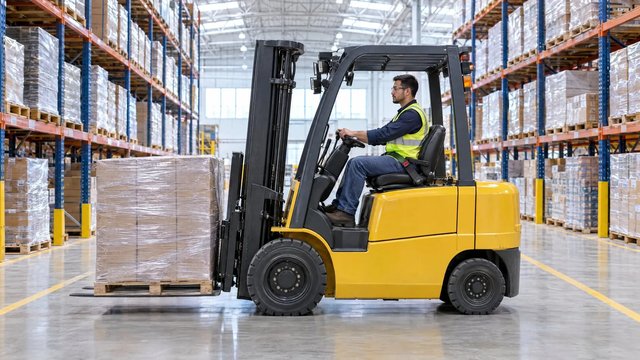
OSHA requires every forklift operator to be trained and evaluated, and certified by their employer, before operating a forklift without supervision. Under 29 CFR 1910.178(l), training has three parts: formal instruction, practical hands-on training, and an evaluation of your driving in the workplace. Your performance must be re-evaluated at least every three years. This guide walks through each requirement, what the employer must record, and where online training fits.
What OSHA requires
The forklift standard, 29 CFR 1910.178, covers all powered industrial trucks: sit-down counterbalance forklifts, stand-up reach trucks, order pickers, electric pallet jacks and walkies, rough-terrain forklifts and similar equipment. Paragraph (l) sets the operator training rules, and the construction standard (1926.602(d)) points back to the same requirements.
The core rule is simple: the employer must make sure each operator is competent to operate a powered industrial truck safely, as shown by successful completion of training and evaluation. Until then, a trainee may only operate a truck under the direct supervision of someone with the knowledge, training and experience to train operators, and only where it does not endanger anyone.
The 3 parts of forklift training
1. Formal instruction
Lecture, discussion, interactive computer learning, video or written material. This is the part that can be done online.
2. Practical training
Demonstrations by the trainer and practical exercises by the trainee on the truck.
3. Evaluation
A qualified person watches you operate the truck in your workplace and confirms you can do it safely.
All three are required. A course certificate on its own shows you finished the formal instruction; it does not make you a certified operator until your employer completes the practical training and evaluation. OSHA does not approve, certify or accredit online forklift training providers, and no online course can replace the hands-on evaluation.
Topics the training must cover
OSHA lists the topics in 1910.178(l)(3). Training must cover any that apply to the truck and the workplace:
- Truck-related topics: operating instructions and warnings, differences from a car, controls and instruments, engine or motor operation, steering and maneuvering, visibility, fork and attachment use, vehicle capacity and stability, daily inspection and maintenance, refueling or battery charging, and any other instructions in the operator’s manual.
- Workplace-related topics: surface conditions, load composition and stability, load handling and stacking, pedestrian traffic, narrow aisles and restricted places, hazardous (classified) locations, ramps and sloped surfaces, closed environments where exhaust can build up, and other unique conditions.
Operators also need to understand the stability triangle and load center, because tip-overs are one of the most common causes of forklift deaths. Wearing the seat belt and staying in the cab during a tip-over saves lives.
Get your Forklift certificate today
Theory 100% online · unlimited free retakes · instant certificate + printable wallet card · employer practical evaluation required
What the employer must certify
Under 1910.178(l)(6), the employer must certify that each operator has been trained and evaluated. The certification must include:
- The operator’s name.
- The date of the training.
- The date of the evaluation.
- The identity of the person or persons performing the training or evaluation.
OSHA does not issue forklift licenses, and there is no state forklift license. When people say “forklift license” or “forklift card,” they mean this employer certification and the training records behind it.
Refresher training and the 3-year evaluation
An evaluation of each operator’s performance must happen at least once every three years. Refresher training, with a new evaluation, is also required whenever:
- The operator has been seen operating the truck unsafely.
- The operator has been involved in an accident or near-miss.
- An evaluation shows the operator is not operating the truck safely.
- The operator is assigned to drive a different type of truck.
- A change in the workplace could affect safe operation.
Training already completed does not have to be repeated if the employer evaluates the operator and confirms they are competent on that topic, which is helpful when you change jobs with a recent certificate.
Daily inspections are part of the job
Training is not the only operator duty. Under 1910.178(q)(7), every truck must be examined before being placed in service, and it must not be used if the examination shows a condition that affects safety. Trucks in use around the clock must be checked after each shift. A typical pre-shift check covers:
- Forks, chains, mast and overhead guard for cracks, bends or damage.
- Tires, wheels and fluid levels, plus any leaks under the truck.
- Horn, lights, backup alarm, brakes, parking brake, steering and seat belt.
- Battery connections and charge on electric trucks, or the propane tank and hose on LP trucks.
Any defect must be reported, and the truck taken out of service until it is repaired.
Who needs it, and why it matters
Anyone who drives a powered industrial truck at work needs to be trained and evaluated, including part-time and temporary workers. Common workplaces include:
Federal child labor rules prohibit workers under 18 from operating forklifts in non-agricultural jobs. The forklift standard is regularly on OSHA’s list of most frequently cited standards, and serious violations can cost an employer more than $16,000 each.
Frequently asked questions
Does OSHA require forklift certification?
Yes. OSHA 29 CFR 1910.178(l) requires employers to train and evaluate every forklift operator and certify that this has been done before the operator works without supervision.
How often do forklift operators need to be re-certified?
An evaluation of each operator’s performance is required at least once every three years, and sooner after an accident, near-miss, unsafe operation, a change of truck type or a change in the workplace.
Is online forklift certification OSHA compliant?
Online training can cover the formal instruction part of 1910.178(l). To be complete, your employer must add practical training and an evaluation of your driving on the actual truck in the workplace. OSHA does not approve or certify online providers.
Who can do the forklift evaluation?
A person with the knowledge, training and experience to train operators and evaluate their competence. This is often a supervisor, lead operator or safety coordinator chosen by the employer.
Does a forklift certification transfer to a new job?
Not automatically. Your new employer must make sure you are trained on their trucks and workplace and must evaluate you before certifying you. Recent training can count toward this if the employer confirms you are competent.
Is there a forklift license in the US?
No. OSHA and the states do not issue forklift licenses. Your proof is your training certificate plus your employer’s certification of training and evaluation.
Related