
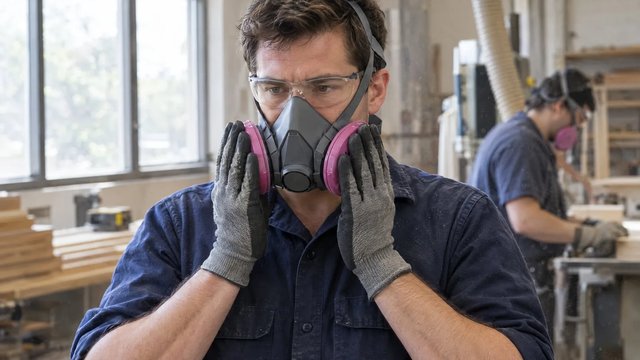
When a respirator is required at work, OSHA’s Respiratory Protection Standard (29 CFR 1910.134) requires a written program, a medical evaluation, a fit test before first use and at least once a year, and training before use and every year after. Tight-fitting respirators only work when they seal to the face, which is why fit testing and seal checks matter so much. This guide explains each requirement, the difference between qualitative and quantitative fit testing, and what online training can cover.
When are respirators required?
OSHA’s first choice is always to control airborne hazards at the source with engineering controls (ventilation, enclosure, substitution of less toxic materials) and work practices. Respirators are required when those controls are not feasible, while they are being installed, or when they do not reduce exposure enough. They are also required in emergencies.
Respirators are common in:
When respirators are required, the employer must provide them at no cost and run a written respiratory protection program with worksite-specific procedures, managed by a suitably trained program administrator.
What the written program must include
- Procedures for selecting respirators based on the hazards and exposure levels.
- Medical evaluations of employees required to use respirators.
- Fit testing procedures for tight-fitting respirators.
- Procedures for proper use in routine and reasonably foreseeable emergencies.
- Cleaning, disinfecting, storing, inspecting, repairing and discarding respirators.
- Ensuring adequate air quality for atmosphere-supplying respirators.
- Training on respiratory hazards and on proper use, limitations and maintenance.
- Regular evaluation of the program’s effectiveness.
For air-purifying respirators against gases and vapors, the program must include a cartridge change schedule unless the cartridge has an end-of-service-life indicator. Respirators are chosen using assigned protection factors: for example, a half-mask air-purifying respirator has an APF of 10 and a full facepiece has an APF of 50.
Medical evaluation comes first
Breathing through a respirator puts extra strain on the heart and lungs. Before a worker is fit tested or uses a respirator, a physician or other licensed health care professional must evaluate whether they can safely wear it, usually through the confidential questionnaire in Appendix C of the standard or an equivalent exam. The employer receives only a written recommendation about the worker’s ability to use the respirator, not their medical details. Follow-up evaluations are required when, for example, the worker reports symptoms or workplace conditions change.
Get your Respiratory Protection certificate today
100% online · unlimited free retakes · instant certificate + printable digital wallet card
Fit testing: qualitative vs quantitative
Every worker using a tight-fitting respirator (including N95 filtering facepieces, half masks and full facepieces) must pass a fit test with the same make, model, style and size they will use. Fit testing is required before first use, whenever a different facepiece is used, at least once a year, and when changes such as major weight change, dental work or facial scarring could affect the fit.
Qualitative (QLFT)
Pass or fail, based on whether the wearer can taste or smell a test agent such as saccharin, Bitrex or isoamyl acetate, or reacts to irritant smoke. Only allowed for negative-pressure respirators that need a fit factor of 100 or less, such as half masks and N95s.
Quantitative (QNFT)
An instrument measures leakage into the facepiece and gives a numerical fit factor. Required for full-facepiece negative-pressure respirators used where a fit factor above 100 is needed. A half mask must reach at least 100 and a full facepiece at least 500.
Fit testing is a hands-on test with the actual respirator on your face, so it cannot be done online. Your employer arranges it using one of the OSHA-accepted protocols in Appendix A.
Seal checks and facial hair
Every time you put on a tight-fitting respirator, do a user seal check: a positive-pressure check (exhale gently with the exhalation valve covered) and a negative-pressure check (inhale gently with the inlets covered). If air leaks around the edges, adjust and try again; if it still leaks, do not enter the hazard area.
Tight-fitting respirators may not be worn by anyone with facial hair that comes between the sealing surface and the face, or that interferes with valve function. Stubble counts. Workers who cannot be clean-shaven for religious or medical reasons may be able to use a loose-fitting powered air-purifying respirator (PAPR) instead.
Training and voluntary use
Workers must be trained before they first use a respirator and at least once a year after that, and again when workplace conditions or respirator types change. They must be able to explain why the respirator is needed, how fit and maintenance affect protection, its limits, how to use it in emergencies, how to inspect, put on, remove and seal check it, how to clean and store it, and what medical signs and symptoms limit its use.
Voluntary use: if a worker chooses to wear a respirator when it is not required, the employer must give them the information in Appendix D. If the voluntary respirator is anything other than a filtering facepiece (dust mask), the employer must also provide a medical evaluation and cleaning and storage procedures.
OSHA does not approve, certify or accredit online training providers. An online course covers the knowledge side of the annual training. Your employer must still provide the medical evaluation, the fit test and hands-on practice with your actual respirator. With Gama Safety you pass the exam with 80% or better (unlimited free retakes) and download your certificate and printable wallet card right away.
Frequently asked questions
How often is respirator fit testing required?
Before first use, whenever a different respirator facepiece is used, and at least once every 12 months. A new fit test is also needed when physical changes could affect the fit.
Can respirator fit testing be done online?
No. Fit testing requires the worker to wear the actual respirator during a qualitative or quantitative test. Online training covers the knowledge portion only.
Do you need a medical evaluation to wear an N95?
Yes, if the N95 is required by your employer. A medical evaluation is required before fit testing or first use. For purely voluntary use of a filtering facepiece, the employer only needs to give you the Appendix D information.
Can you wear a respirator with a beard?
Not a tight-fitting one if the facial hair touches the sealing surface. Loose-fitting PAPRs and hoods are an option for workers who cannot be clean-shaven.
What is the difference between a seal check and a fit test?
A seal check is a quick positive and negative pressure check the wearer does every time they put the respirator on. A fit test is a formal test, done at least yearly, that confirms a specific respirator model and size fits your face.
Related