
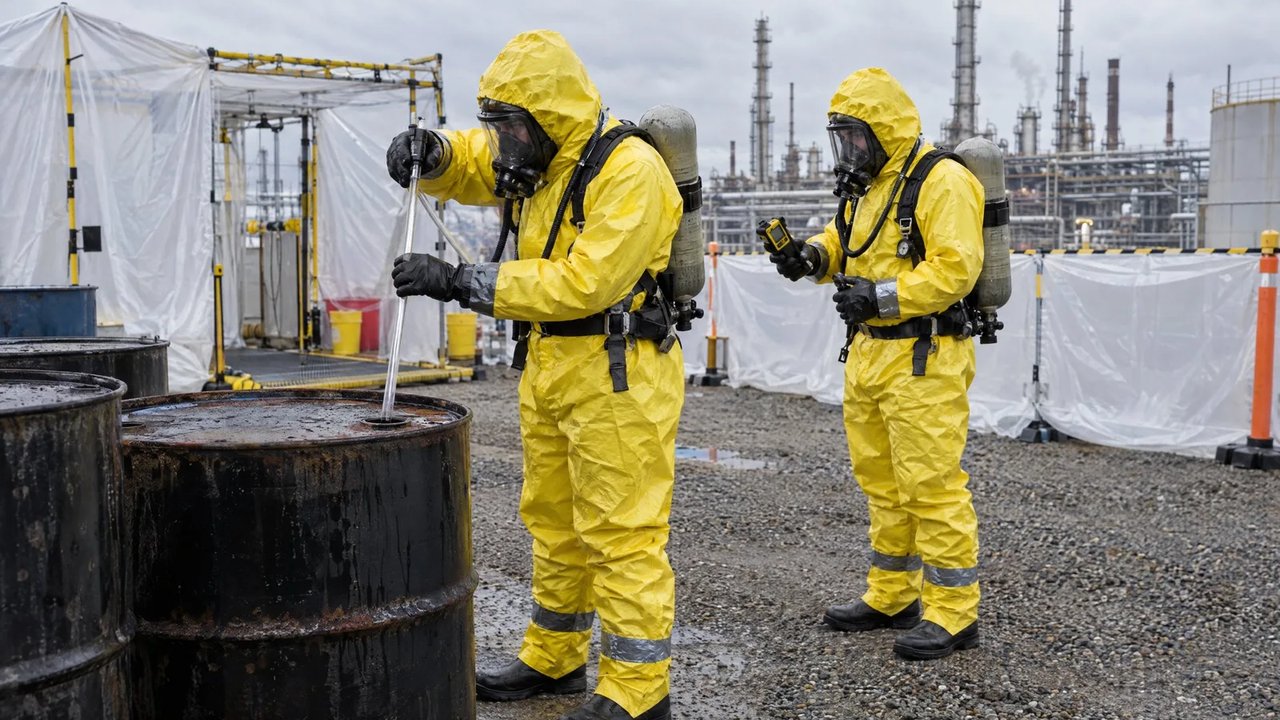
HAZWOPER is the OSHA standard for hazardous waste operations and emergency response, 29 CFR 1910.120 (and 1926.65 in construction). General site workers at uncontrolled hazardous waste sites need 40 hours of off-site instruction plus 3 days of supervised field experience. Occasional or low-exposure workers need 24 hours plus 1 day in the field. Everyone covered then needs an 8-hour refresher every year. This guide explains which level applies to you and what online training can and cannot cover.
What is HAZWOPER?
HAZWOPER stands for Hazardous Waste Operations and Emergency Response. It is the OSHA standard that protects workers who clean up hazardous waste, work at hazardous waste treatment, storage and disposal facilities, or respond to releases of hazardous substances.
The rules are in 29 CFR 1910.120 for general industry, and the construction version, 29 CFR 1926.65, is essentially identical. The standard covers five groups of operations:
- Cleanup operations required by a government body at uncontrolled hazardous waste sites, including EPA National Priorities List (Superfund) sites and state priority sites.
- Corrective actions at sites regulated under the Resource Conservation and Recovery Act (RCRA).
- Voluntary cleanup operations at sites recognized by a government body as uncontrolled hazardous waste sites.
- Operations at RCRA treatment, storage and disposal (TSD) facilities.
- Emergency response to releases, or substantial threats of releases, of hazardous substances, wherever they happen.
If your work falls into one of these groups, your employer must provide HAZWOPER training before you do the work.
40-hour vs 24-hour: which do you need?
For hazardous waste site cleanup work, the training level depends on how often you are on site and how likely you are to be exposed. These are the rules in 1910.120(e)(3):
40 hours + 3 days
General site workers (equipment operators, general laborers and others) exposed or potentially exposed to hazardous substances or health hazards.
24 hours + 1 day
Workers on site only occasionally for a specific, limited task who are unlikely to be exposed over permissible exposure limits.
24 hours + 1 day
Workers regularly on site in areas that are monitored and fully characterized, where exposure is under limits and respirators are not needed.
A worker with 24 hours of training who later becomes a general site worker, or who is required to wear a respirator, needs the additional 16 hours and 2 days of field experience to reach the 40-hour level.
Supervisors and managers directly responsible for site operations need the same training as the workers they supervise plus at least 8 more hours of specialized training on topics such as the safety and health program, PPE program, spill containment and health hazard monitoring.
TSD facility workers follow a separate rule in 1910.120(p): 24 hours of initial training plus 8 hours of refresher training every year. Emergency responders follow 1910.120(q), which sets levels from First Responder Awareness up to Hazardous Materials Technician (at least 24 hours), Specialist and On-Scene Incident Commander.
Supervised field experience: the part you cannot do online
The 40-hour and 24-hour requirements each have two parts: off-site instruction (the classroom hours) and actual field experience under the direct supervision of a trained, experienced supervisor. The field days are separate from the 40 or 24 hours.
Online HAZWOPER training covers the instruction portion. It cannot replace the field days. OSHA has also said in interpretation letters that computer-based training on its own is not enough: workers need hands-on practice with the equipment they will use (for example respirators and protective clothing) and access to a qualified trainer who can answer their questions.
OSHA does not approve, certify or accredit any online training provider. In practice, the online course gives you the knowledge base, and your employer arranges the supervised field experience and site-specific training on the actual hazards, PPE, decontamination and emergency procedures at your site.
Get your HAZWOPER 40-Hour certificate today
100% online · unlimited free retakes · instant certificate + printable digital wallet card
What HAZWOPER training covers
Under 1910.120(e)(2), training must cover at least:
- The names of the personnel and alternates responsible for site safety and health.
- The safety, health and other hazards present on the site.
- Use of personal protective equipment.
- Work practices that minimize risk.
- Safe use of engineering controls and equipment on the site.
- Medical surveillance, including recognizing symptoms and signs of overexposure.
- The decontamination procedures and emergency response plan from the site safety and health plan.
A good 40-hour course also teaches toxicology basics, site characterization, air monitoring, levels of protection (A, B, C and D), respirator types, confined spaces, the site safety and health plan, and spill containment.
The 8-hour annual refresher
Workers and supervisors who completed the 40-hour or 24-hour training must take at least 8 hours of refresher training every year (1910.120(e)(8)). The refresher can cover a review of the initial topics, recent incidents and relevant changes, and it is commonly taken online.
If you miss your annual refresher, the standard does not say you must repeat the full 40 hours, but you should complete the refresher as soon as possible and your employer should confirm your knowledge is still current before you go back to covered work. Some employers and clients have stricter rules, so check before your deadline passes.
HAZWOPER certificates and records
The standard requires that workers who complete the training and field experience be certified by their instructor or head instructor and trained supervisor, and that each person gets a written certificate. Anyone without that certification may not take part in hazardous waste operations.
A typical sequence looks like this:
- Complete the online 40-hour instruction at your own pace. Progress saves automatically, so you can spread it over a week or two.
- Pass the final exam with 80% or better. Retakes are unlimited and free.
- Download your certificate and printable wallet card for the instruction portion as soon as you pass.
- Complete 3 days of supervised field experience arranged by your employer, who documents it and keeps the record.
- Take the 8-hour refresher before the 12 months are up, every year.
Training a crew? Team accounts start at 2 seats, with a dashboard to see who has finished.
Frequently asked questions
Who needs HAZWOPER 40-hour training?
General site workers at uncontrolled hazardous waste sites, such as equipment operators and laborers, who are exposed or potentially exposed to hazardous substances. They need 40 hours of off-site instruction plus 3 days of supervised field experience under 29 CFR 1910.120(e)(3).
Can I take HAZWOPER 40 online?
You can complete the 40 hours of instruction online. The 3 days of supervised field experience and hands-on practice with PPE and respirators must be done in person, and your employer is responsible for arranging them. OSHA does not approve or certify online providers.
How long is a HAZWOPER certificate good for?
There is no fixed expiry date for the initial training, but you must complete at least 8 hours of refresher training every year to keep working in HAZWOPER operations.
What is the difference between HAZWOPER and HAZMAT training?
HAZWOPER (29 CFR 1910.120) covers hazardous waste cleanup, TSD facilities and emergency response. HAZMAT training under DOT rules (49 CFR 172.704) covers people who prepare, ship or transport hazardous materials. Some jobs need both.
Do supervisors need more HAZWOPER training?
Yes. On-site managers and supervisors need the same training as their workers plus at least 8 additional hours of specialized training on managing hazardous waste operations.
Can I do the 40 hours in one week?
Yes, many people finish in about a week. The online course saves your progress so you can also spread it out over several sessions on any device.
Related