
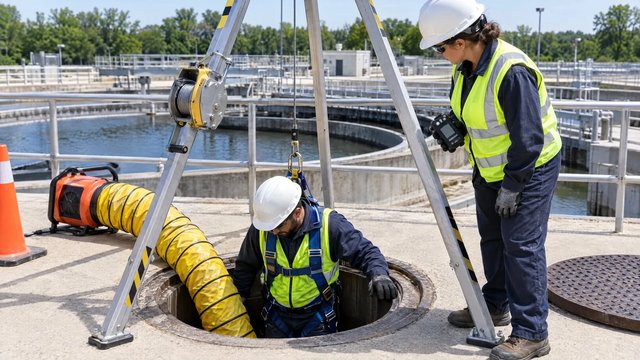
A permit-required confined space is a confined space with at least one serious hazard: a hazardous atmosphere, a material that could engulf a worker, a shape that could trap or suffocate someone, or any other serious safety or health hazard. OSHA regulates these spaces under 29 CFR 1910.146 for general industry and 29 CFR 1926 Subpart AA for construction. Entry requires a written permit, atmospheric testing, an attendant outside, and a rescue plan. This guide explains how to identify these spaces and what the rules require.
What counts as a confined space?
Under OSHA’s definition, a confined space meets all three of these conditions:
- It is large enough and configured so that a worker can bodily enter and do assigned work.
- It has limited or restricted means of entry or exit.
- It is not designed for continuous employee occupancy.
Common examples include:
Being a confined space does not by itself mean it is dangerous. The next question is whether it is permit-required.
When is a confined space permit-required?
A confined space is a permit-required confined space (permit space) if it has one or more of these characteristics:
Hazardous atmosphere
Contains, or could contain, a toxic, flammable or oxygen-deficient or enriched atmosphere.
Engulfment
Contains material such as grain, sand or liquid that could surround and suffocate a worker.
Trapping shape
Inwardly converging walls or a floor that slopes down to a smaller cross-section, which could trap or asphyxiate an entrant.
Other serious hazard
Any other recognized serious hazard, such as moving machinery, live electrical parts, extreme heat or falls.
Employers must evaluate the workplace to find permit spaces, post danger signs (or use an equally effective method) to tell workers about them, and prevent unauthorized entry. A space can be reclassified as a non-permit space only when all hazards are eliminated, and that must be documented.
Atmospheric testing and hazardous atmospheres
Before anyone enters, the internal atmosphere must be tested with a calibrated, direct-reading instrument. Test in this order:
- Oxygen, because most combustible gas meters need enough oxygen to read accurately.
- Combustible (flammable) gases and vapors.
- Toxic gases and vapors, such as hydrogen sulfide and carbon monoxide.
OSHA treats the atmosphere as hazardous when, among other conditions, oxygen is below 19.5% or above 23.5%, flammable gas or vapor is above 10% of its lower flammable limit (LFL), combustible dust is at or above its LFL (roughly when it hides a target 5 feet away), or a toxic substance is above its permissible exposure limit. Test vertical spaces at different levels, since some gases are heavier and others lighter than air, and keep monitoring during the entry.
Get your Confined Space Entry certificate today
100% online · unlimited free retakes · instant certificate + printable digital wallet card
The entry permit and who does what
The entry permit documents that the space is safe to enter. It must list the space, the purpose and duration of entry, the authorized entrants, the attendant and entry supervisor, the hazards, how they are isolated or controlled, acceptable entry conditions, test results with the tester’s initials and times, rescue services and how to call them, communication methods, required equipment and any other permits (such as hot work). The permit cannot last longer than the job. Cancelled permits are kept for at least one year so the program can be reviewed.
- Authorized entrant: knows the hazards and signs of exposure, uses the equipment properly, stays in contact with the attendant, and gets out when told to or when they notice a warning sign.
- Attendant: stays outside the space for the whole entry, keeps count of entrants, monitors conditions, orders evacuation, calls rescue, and never enters to attempt a rescue unless trained and relieved.
- Entry supervisor: checks the permit, confirms tests and rescue arrangements, signs the permit to authorize entry, and cancels it when the work is done or conditions change.
Rescue: the step people skip
NIOSH research found that about 60% of confined space deaths were would-be rescuers, often co-workers who went in without protection to help. That is why OSHA requires a rescue plan before entry.
- Rescue can be an in-house team or an outside service, but it must be able to respond in time for the hazards in that space.
- Rescue team members must be trained, and at least one must hold current first aid and CPR certification. They must practice a permit-space rescue at least once every 12 months.
- Non-entry rescue is preferred. To make it possible, entrants usually wear a full-body harness attached to a retrieval line, and a mechanical retrieval device is required for vertical spaces more than 5 feet deep.
Confined space training requirements
Employers must train every worker with permit space duties so they can do those duties safely. Training is required before the worker is first assigned, before any change in duties, when a new hazard appears, and when the employer sees the worker is not following procedures. The employer must certify the training with each employee’s name, the trainer’s signature or initials, and the dates.
OSHA does not approve, certify or accredit online training providers. An online confined space course covers the rules, hazards, atmospheric testing, roles and rescue planning. Your employer must add site-specific training on its own spaces, permit system, gas monitors and retrieval equipment, plus hands-on practice. With Gama Safety you pass the exam with 80% or better (unlimited free retakes) and download your certificate and printable wallet card right away.
Frequently asked questions
What is the difference between a confined space and a permit-required confined space?
A confined space is large enough to enter, has limited entry or exit, and is not designed for continuous occupancy. It becomes permit-required when it also has a serious hazard: a hazardous atmosphere, engulfment, a trapping shape or another serious safety or health hazard.
What oxygen level is safe for confined space entry?
OSHA considers an atmosphere hazardous when oxygen is below 19.5% or above 23.5%. Normal air is about 20.9% oxygen.
Who can sign a confined space entry permit?
The entry supervisor signs the permit to authorize entry, after confirming the tests, controls and rescue arrangements are in place.
Does the confined space attendant ever go inside?
The attendant must stay outside the space for the whole entry and cannot enter to attempt a rescue unless trained and equipped for rescue and relieved by another attendant.
Which OSHA standard covers confined spaces in construction?
Construction work is covered by 29 CFR 1926 Subpart AA (1926.1200 to 1926.1213), which took effect in 2015. General industry is covered by 1910.146.
Related