
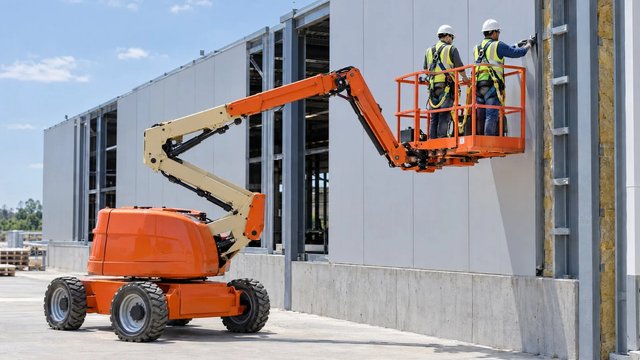
OSHA says only trained and authorized people may operate an aerial lift, and the ANSI A92 standards spell out how that training should be done: theory, hands-on practice, and familiarization on the specific machine. Boom lifts fall under OSHA’s aerial lift rules (29 CFR 1926.453 in construction and 1910.67 in general industry). Scissor lifts are treated by OSHA as mobile scaffolds. This guide explains the rules for each, the MEWP categories, fall protection, and what an online course can cover.
Which OSHA rules apply?
OSHA does not have one single “aerial lift certification” rule. Several standards work together:
- 29 CFR 1926.453 (construction) covers vehicle-mounted aerial devices used to raise workers: extensible boom platforms, aerial ladders, articulating boom platforms, vertical towers and combinations of these. It requires that only authorized persons operate an aerial lift.
- 29 CFR 1910.67 (general industry) covers vehicle-mounted elevating and rotating work platforms and says only trained persons may operate an aerial lift.
- Scissor lifts are treated by OSHA as mobile scaffolds, covered by the scaffold standards (1926.451 and 1926.452(w) in construction). Scaffold users must be trained by a qualified person under 1926.454.
- General training duty: in construction, 1926.21(b)(2) requires employers to train each worker to recognize and avoid unsafe conditions.
In practice, OSHA inspectors also look at the manufacturer’s operating manual and the ANSI A92 standards as the recognized way to train operators.
Scissor lift vs boom lift
Scissor lift (MEWP Group A)
Moves straight up and down. The platform stays inside the machine’s tipping lines. Guardrails are the primary fall protection. Most are Type 3a: they can drive while raised, controlled from the platform.
Boom lift (MEWP Group B)
Telescoping or articulating boom that can reach up and out beyond the base. Workers must wear a harness with a lanyard attached to the boom or basket. Most are Type 3b.
“MEWP” means mobile elevating work platform, the term used by the ANSI A92 standards. Group A machines keep the platform within the tipping lines; Group B machines can move it outside them. Type 1 machines can only travel when stowed, Type 2 can travel raised with controls on the chassis, and Type 3 can travel raised with controls on the platform.
Because the hazards differ, an operator trained only on scissor lifts is not automatically qualified on a boom lift, and the reverse is also true.
What ANSI A92 requires
The ANSI/SAIA A92 MEWP standards took effect in 2020. They are voluntary consensus standards, but they are widely written into company policies, rental agreements and contracts, and OSHA can use them as evidence of recognized practice. They require three things for operators:
- Training: theory (the rules, hazards and safe operation) plus practical, hands-on operation of a MEWP of the same group and type, given by a qualified person.
- Familiarization: before using a specific make and model, the operator learns its controls, safety devices, limits and manual.
- Proof of training: trained operators receive documentation, often a card or certificate, that lists the MEWP groups and types they are trained on.
The standards also cover occupants (people who ride in the platform but do not operate it) and supervisors, and they require a safe use plan and a rescue plan for every job.
Get your Scissor Lift certificate today
Theory 100% online · unlimited free retakes · instant certificate + printable wallet card · employer practical evaluation required
Key safety rules on the job
- Inspect before use. Lift controls must be tested each day before use (1926.453(b)(2)(i)), and the manufacturer’s pre-start inspection should be done every shift.
- Stand on the platform floor. Never sit or climb on the guardrails, or use planks, ladders or other devices to gain height.
- Use fall protection on boom lifts. Wear a full-body harness with a lanyard attached to the anchor point on the boom or basket, never to a nearby structure. Body belts are no longer allowed for fall arrest.
- Respect load limits. Never exceed the rated capacity of the platform, including people, tools and materials.
- Keep clear of power lines. Stay at least 10 feet away from overhead lines up to 50 kV, and farther for higher voltages, unless the lines are de-energized and grounded.
- Check the ground. Avoid drop-offs, holes, soft ground and slopes beyond the manufacturer’s limits. Tip-overs and falls cause most aerial lift deaths.
- Watch the weather. Follow the manufacturer’s wind limits; many scissor lifts are rated for indoor use only.
Can you get aerial lift certified online?
You can complete the theory part online. That covers the regulations, hazards, inspections, stability, fall protection and safe operating rules. It cannot replace the practical training and familiarization on the actual machine. OSHA does not approve, certify or accredit online training providers, and your employer must add a practical evaluation on the lift you will use before you operate it on your own.
- Take the online course for the lift type you need: scissor lift or boom lift.
- Pass the exam with 80% or better. Retakes are unlimited and free.
- Download your certificate and printable wallet card right away.
- Complete hands-on training, an evaluation and familiarization with your employer on the specific make and model.
OSHA does not set a fixed renewal period for aerial lift training. Retraining is needed when an operator is seen operating unsafely, is involved in an incident, or moves to a different type of machine. Many employers and rental companies refresh training every three years.
Frequently asked questions
Does OSHA require scissor lift certification?
OSHA requires that scissor lift users be trained by a qualified person, because OSHA treats scissor lifts as mobile scaffolds under the scaffold standards (1926.451, 1926.452(w) and 1926.454). The employer decides who is authorized and keeps the records.
Do you need a harness in a scissor lift?
OSHA treats the scissor lift guardrail system as the primary fall protection, so a harness is not required by OSHA as long as the guardrails are in place and you stay on the platform floor. Some manufacturers and employers require one anyway; follow their rules.
Do you need a harness in a boom lift?
Yes. Under 1926.453(b)(2)(v), workers in a boom lift must wear fall protection with a lanyard attached to the boom or basket. Today that means a full-body harness, since body belts are no longer allowed for fall arrest.
Is aerial lift certification good for both scissor and boom lifts?
Only if the training covered both. Scissor lifts (Group A) and boom lifts (Group B) have different hazards, so operators need training and familiarization on each group and type they will use.
How long does aerial lift certification last?
OSHA sets no fixed expiry, but retraining is needed after unsafe operation, an incident, or a change of machine type. Many employers and rental companies refresh training every three years.
Related