
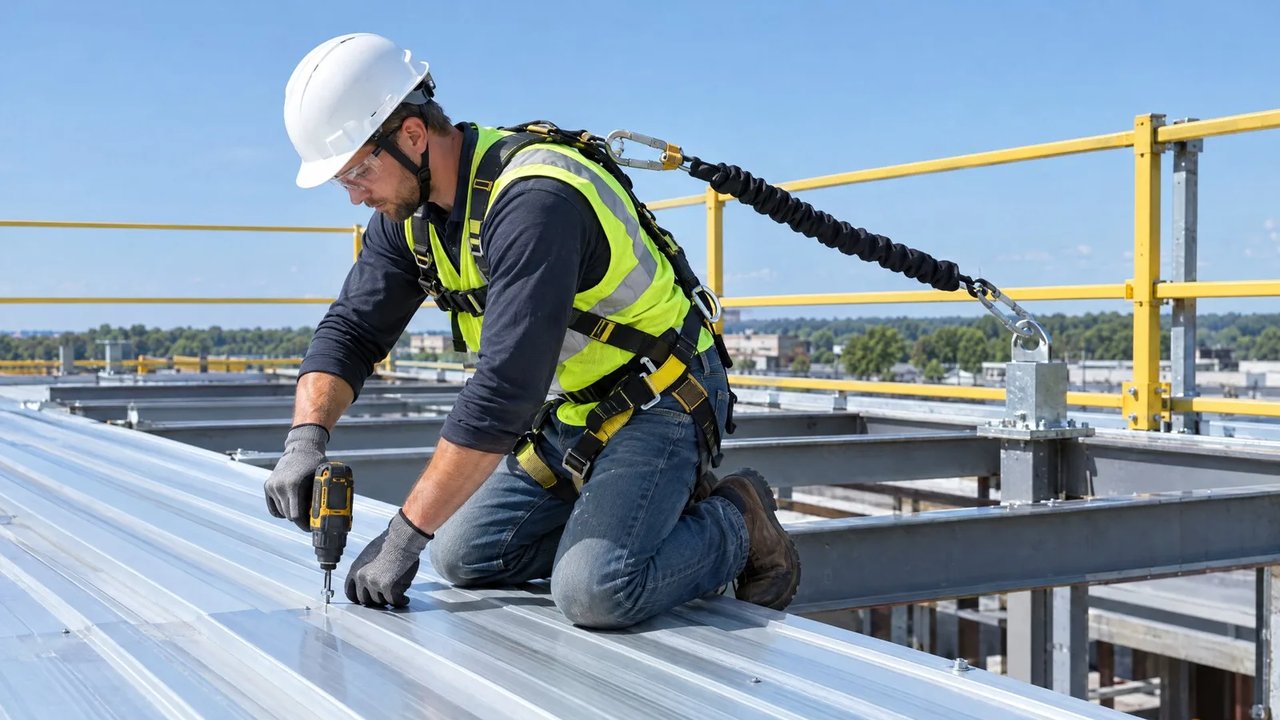
OSHA requires fall protection at 4 feet in general industry, 6 feet in construction, 5 feet in shipyards and 8 feet in longshoring, and at any height when working over dangerous equipment. Scaffolds trigger fall protection at 10 feet. Protection can be guardrails, safety nets or a personal fall arrest system, and workers must be trained to recognize fall hazards. This guide lays out the height rules, the key equipment requirements, and what training is required.
Fall protection heights by industry
The trigger height depends on the industry and the type of work:
4 ft
General industry
Unprotected sides and edges of walking-working surfaces (1910.28(b)(1)).
6 ft
Construction
Unprotected sides and edges, leading edges, holes, roofs and excavations (1926.501).
10 ft
Scaffolds
Workers on scaffolds more than 10 feet above a lower level (1926.451(g)).
Any height
Over dangerous equipment
Above machinery, vats, open pits or anything that could cause injury if someone fell in or onto it.
Other thresholds include 5 feet in shipyards, 8 feet in longshoring, and in steel erection 15 feet for most work and 30 feet (or two stories) for connectors under Subpart R. In construction, a stairway or ladder is required at any point where there is a break in elevation of 19 inches or more and no ramp or other safe access.
What counts as fall protection?
OSHA expects employers to eliminate the hazard first, for example by doing work from the ground, then to use passive systems, and only then personal equipment. The main options are:
- Guardrail systems. Top rail at 42 inches (plus or minus 3 inches) above the walking surface, a midrail or equivalent about halfway between, and able to withstand 200 pounds of force applied to the top rail.
- Safety net systems, installed as close as practical under the work surface and never more than 30 feet below it.
- Covers over holes, able to support at least twice the weight of workers, equipment and materials, secured and marked “HOLE” or “COVER.”
- Personal fall arrest systems: a full-body harness, a connector such as a lanyard or self-retracting lifeline, and an anchorage.
- Travel restraint and positioning systems, which keep a worker from reaching the edge or hold them in place while they work.
- Warning lines, safety monitoring and controlled access zones, allowed only in specific situations such as low-slope roofing or leading-edge work.
Personal fall arrest system rules
If you use a harness and lanyard, these numbers matter (1926.502(d) and 1910.140):
- Free fall must be limited to 6 feet, and the worker must not be able to hit a lower level.
- Maximum arresting force on the worker is 1,800 pounds with a full-body harness.
- Deceleration distance must be no more than 3.5 feet.
- Anchorages must support at least 5,000 pounds per attached worker, or be designed, installed and used under the supervision of a qualified person with a safety factor of at least two.
- Body belts may not be used for fall arrest. They are only allowed for positioning.
- Equipment must be inspected before each use, and any equipment that has arrested a fall must be removed from service until a competent person says it is safe.
Always calculate total fall clearance: free fall, deceleration distance, harness stretch, the worker’s height and a safety margin. A 6-foot lanyard often needs about 18 feet or more of clearance below the anchor.
Get your Fall Protection certificate today
100% online · unlimited free retakes · instant certificate + printable digital wallet card
Rescue after a fall
Employers must provide for prompt rescue of workers who fall, or make sure they can rescue themselves. A worker hanging in a harness can develop suspension trauma within minutes, so a rescue plan, the right equipment and trained people must be ready before work starts. Trauma straps on harnesses can help a suspended worker relieve pressure on their legs while waiting.
Fall protection training requirements
In construction (1926.503), every worker who might be exposed to fall hazards must be trained by a competent person to recognize the hazards and use the systems correctly. The employer must keep a written certification record with the worker’s name, the date of training and the signature of the trainer or employer. Retraining is required when the workplace or equipment changes, or when a worker’s knowledge or use of fall protection is inadequate.
In general industry (1910.30), workers who use personal fall protection or work on certain equipment must be trained by a qualified person before exposure, in a language and vocabulary they understand. Retraining follows the same triggers.
Falls are the leading cause of death in construction, and the construction fall protection standard (1926.501) has been OSHA’s most frequently cited standard for well over a decade.
OSHA does not approve, certify or accredit online training providers. An online course covers hazard recognition, the rules and how the systems work. Your employer must add hands-on training with the actual harnesses, anchors and rescue equipment you will use and confirm you can use them correctly. With Gama Safety you pass the exam with 80% or better (unlimited free retakes) and download your certificate and printable wallet card right away.
Frequently asked questions
At what height is fall protection required by OSHA?
4 feet in general industry, 6 feet in construction, 5 feet in shipyards, 8 feet in longshoring and 10 feet on scaffolds. Over dangerous equipment, fall protection is required at any height.
What is the OSHA guardrail height?
The top rail must be 42 inches above the walking-working surface, plus or minus 3 inches, with a midrail or equivalent protection between the top rail and the surface.
How much weight must a fall protection anchor hold?
At least 5,000 pounds per attached worker, or it must be designed and used under the supervision of a qualified person with a safety factor of at least two.
Can I use a body belt for fall protection?
Not for fall arrest. Body belts are allowed only for positioning. Fall arrest requires a full-body harness.
How often is fall protection training required?
OSHA requires training before a worker is exposed to fall hazards and retraining when the workplace or equipment changes or the worker shows gaps in knowledge. There is no fixed interval, but many employers refresh it every year.
Related